Showing posts with label Summerwind. Show all posts

Monday, May 2, 2011

The Marcha gait - more from the Clinic

My notes from the clinic:


Ø  Perfect the 4 beat extended walk.  (How many times are we told to practice a good walk in other disciplines?)  It is ESSENTIAL for a good marcha as it is the take-off point and retreat point always.
Ø  Practice in straight lines before teaching in circles, lateral work or ANY other discipline.  Teach the horse to elongate his back, his stride, relax and stretch without speeding up.
Ø  Always start on the good side for the stretches, but do both sides.  Stretching from the good side will help the bad side to stretch easier.
Ø  To move into gait:  From the walk, apply more leg pressure and ask the horse to speed up without losing the smooth rhythm that was there in his walk.  Collect the reins (have contact) with the horse’s mouth to ask him to collect his body in a good frame.
Ø  Do NOT let your horse continue to gait if it is gaiting badly.  Go back to the walk and start again.  Ask for MORE SPEED from his legs while maintaining the collection.   You are trying to build MUSCLE MEMORY.  (This works really well!  I tried it on my horses after the clinic)
Ø  A marcha picada horse that paces is often still very smooth (I was surprised by this).  You can tell because your hips will go side to side instead of forward and back.  Try to put your leg on for more leg speed, but if that doesn’t work, return to the walk and start over.
Ø  In marcha picada, you can help the horse learn the right rhythm by adding weight to the front feet (could be shoes) or the opposite in marcha batida.
Ø  As you can see from the diagram on May 1's post, some horses will need help because of poorer conformation or breeding, but some horses need correction because someone interfered with their natural gait during training.  The Marchador is a willing partner.  If you ask it to change its natural footfall, it will learn to do what you want.
Ø  You can use dressage to supple the horse and build muscle, but not too soon (remember straight lines).  Once you can do the circles, you can move to a higher-level figure.  The Marchador can do lateral work and the higher moves IN GAIT!  (Another surprise for me!)


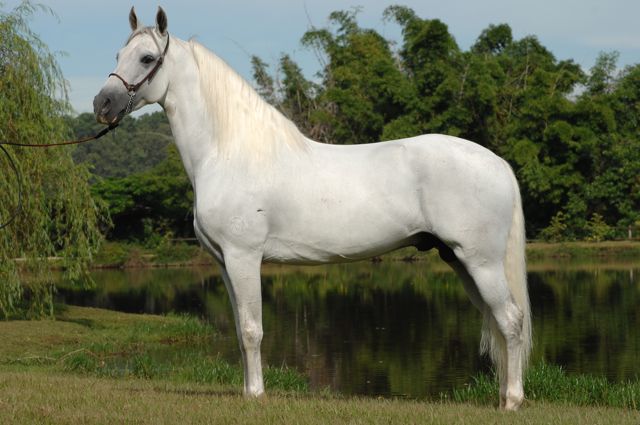
Good breeding ensures a great gait naturally.  This
is Fidalgo do Summerwind, marcha de centro.

Dressage will help to supple the horse, stretch and build the
muscles so it also helps get a smoother and better gait.

Monday, April 25, 2011

We're back in Colorado!

We came back a little early - it turned cold and actually snowed!  Beautiful, but not what we or the horses are used to!  Coming from AZ, they were already slick.

The horses stayed in that day
View from our porch - mountains, what mountains?
 It's not like I don't know snow.  I grew up in New England, and yes, I had horses back there as well.  So, I know what it's like to care for animals with bad weather.  The temperatures are one thing, but the second thing that happens after the snow, is the MUD.

So, it's all about keeping the horses happy.  We have 2 dry lots and 2 small paddocks that we gave up to be trashed and we'll reseed in May.
There are the Rockies in the distance!

And to think, we thought perhaps we would be seeing hummingbirds soon!

Koyote Libertas enjoying the snow the day after
Where are we?   We live in beautiful Pagosa Springs, Colorado.  You may know the name of the town because it's where Pat Parelli's Natural Horsemanship have their summer college and campus.  It's near Durango, Colorado (1 hour west) and Santa Fe NM (3 hours south).  The weather here is usually close to perfect with warm days and cool nights.   The temperatures don't need to be that high because the sun is so strong in this altitude.   We just love it.

If you would like to come and meet a Mangalarga Marchador, we enjoy visitors!


Tuesday, April 12, 2011

Success! First Importation of MM Frozen Semen Arrives!

Summerwind SW FUTURE FOAL PRESS RELEASE
Oma de Maripa, one of the frozen semen donors

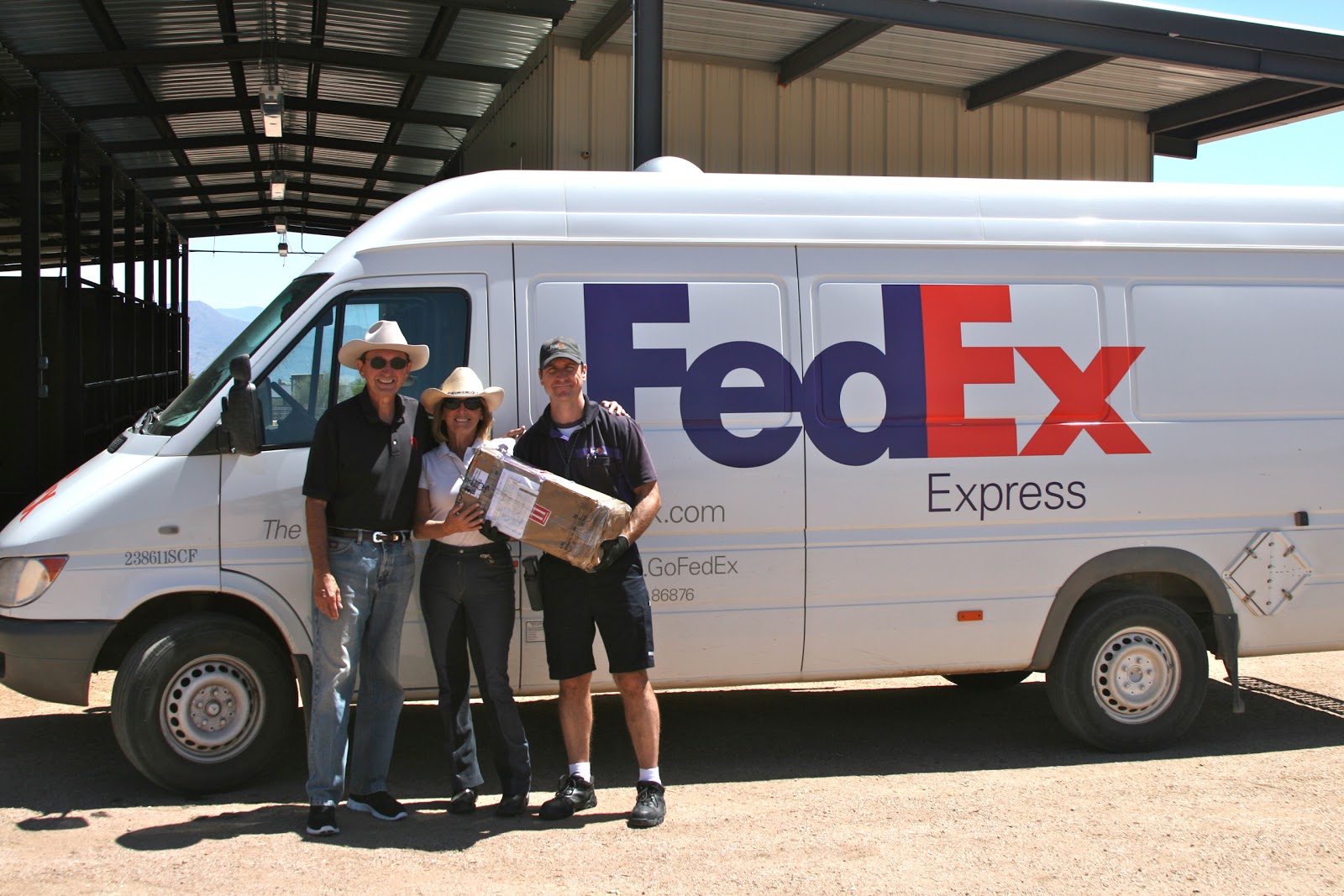
The first shipment of Mangalarga Marchador frozen semen from Brazil arrived in the US April 12, 2011!   The achievement is the result of a 4 year effort by Lynn and John Kelley, Summerwind Marchadors.   It also took the dedication and drive of Mr. Marcelo Baptista de Oliveira of Haras Maripa in Brazil, to navigate the red tape, paperwork and offer 3 of his stallions to be the first to ship to make history.

John and Lynn Kelley meeting the FEDEX truck at
Scottsdale Equine Reproductive Center.
While shipping frozen semen is commonplace these days, in Brazil, the Ministry of Agriculture regulates exportation by horse breed.  Up until recently, they did not allow collection and freezing of semen from Marchador stallions.  The ABCCMM worked with the Ministry of Agriculture and changed their registry rules as well.


Ximoio de Maripa, a semen donor.  Pure Abaiba bloodline.
Summerwind believes that importing frozen semen and embryos provides access to the better horses and proven producers in Brazil.  The Managalarga Marchador is the National Horse of Brazil.  It numbers over 350,000 there.

Haras Maripa breeds Mangalarga Marchador horses as performance and sport horses and have for over 30 years.   Their breeding program combines Abaiba blood mainly, with Bela Cruz and Herdade.   Haras Maripa genetically produces horses which are comfortable to ride, have a rhythmic, smooth movement - a sporting horse, which is sound, robust, has a good conformation, is extremely beautiful, with a good temperament and sweet.  One of their breeding products is in the US, Azenha de Maripa, imported by Summerwind in 2004.   Go see more of their horses!  http://harasmaripa.com.br/
Tiziu de Maripa (3rd semen donor) with owner and breeder,
Mr. Marcelo Baptista at Agro Maripa, SP, Brasil.
In 2003, Zane Davis, MT, wrote about Haras Maripa in his article for Western Horsemen  magazine.  In 2004, Maripa horses were used to ride the historic GOLD TRAIL in Brazil, a journey of about 9,000 miles from Sao Paulo to Golas City.    Now today’s Anhanguera Highway, 300 years ago, it was the main road where all of the wealth of the time traveled (gold, diamonds, slaves, livestock, salt, iron, etc.)        

“The importation of frozen semen and embryos from Brazil is critical to the improvement, diversity and numbers in the Mangalarga Marchador breed in North America.   With only 200 individuals here, you quickly run the risk of in-breeding or breeding horses of lower quality.  We owe Mr. Marcelo a lot.  We don’t know how to repay him for his effort.  This is a dream come true for us.”
Oma de Maripa, (also the top photo) is one of 2 stallions whose semen was frozen and exported.  The son of 2 ELITE book champion horses, himself a champion and a great producer.

The Mangalarga Marchador is one of the most outstanding breeds in the world.  Summerwind is dedicated to promoting and establishing the breed here.  

Summerwind would like to build a frozen sperm bank of champion horses and diverse bloodlines for any Marchador breeder to use.  "Perhaps in this first generation, it is not necessary, but in the next generation and beyond it will be.  That's the advantage of  frozen semen, it will be there forever."    In 2011, John and Lynn will travel to Brazil again to see more stallions and import again.   They will breed some of their mares to Maripa stallions this winter in Scottsdale AZ with their breeding vet, Dr. Jerry Longworth, of Scottsdale Equine Reproductive Center. 

For more information about the Mangalarga Marchador breed, visit Summerwind Marchadors at http://www.summerwindmarchadors.com and http://www.futurefoal.com or the MM association website at http://usmarchador.com. www.namarchador.org

Laio de Maripa, a main herd stallion of Haras Maripa, now in his 20s.  He is the sire of Oma de Maripa (and Azenha de Maripa here in the US).

Quinteto do Pau d'Alho, another great producer at Haras Maripa. Quinteto is the sire of the second stallion who was collected and frozen for exportation to the US, Tiziu de Maripa.


Saturday, April 2, 2011

Fidalgo do Summerwind Baby Book (video)

A great marcha de centro - so fast!

Remember the beautiful baby books that kept the treasures and memories?  Well, we tried to re-create that feeling in this video of Fidalgo for his off-site future owners, Lynn and Becca Boone.   The video is on the long side, but if you like watching foals, then the time will go by quickly.

Fidalgo is a Mangalarga Marchador stud colt who may stay a stallion!  That's great for the breed here, because he is all attitude, style and class!  The perfect son of Brasilia do Summerwind and La Paz Jivago, we are perfectly pleased with the result!

Saturday, February 26, 2011

Summerwind Newsletter

For more great photos and news about Marchadors from around the country, download our SW Newsletter!  In this issue:

  • Visit to Brazil - excerpts from an article by TWH expert Eldon Eadie
  • Lynn's corner
  • News from Family and Friends
  • SW News

Thursday, February 10, 2011

The Importer Series - Summerwind


The IMPORTERS is a series of articles about the history of the Marchador breed coming to the U.S. and the breeders who brought them in.  This is the third installment of the series — Summerwind Marchadors.  The bloodlines highlighted in this article are Favacho and J.B.
Go to our website to read the full article by downloading the pdf file.

http://www.summerwindmarchadors.com/qlNews_detail.aspx?CI=5046

Saturday, January 1, 2011

Fidalgo do Summerwind - born 1/11/11!

Brasilia do Summerwind's first foal and he did not disappoint!  Unbelievably confident and not afraid of anything new, he is just like his mom and dad.  Great looks and gait, Fidalgo was reserved before birth by Lynn Boone-Mayberry and her daughter Becca.


His birthday is a sign - he will be a great horse, maturing around 15 hands, probably mahogany bay and a fabulous, flashy marcha batida.

Friday, December 24, 2010

Mangalarga Marchador - A Breed Without Frontiers


Nomade de Clarion, MM stallion in Brasil

This was a popular tagline for the ABCCMM for many years.  We forget, because the Mangalarga Marchador breed is so rare here in North America, that it is known and prized around the world, but especially in Brazil!

In its native country, the Brazilian Association of Breeders of Mangalarga Marchador, the ABCCMM, currently has 5,000 members and 400,000 registered horses that live in approximately 22,000 farms!  This generates 43,000 direct jobs and 200,000 indirect jobs. 

In Brasil, Marchador horses break records in agribusiness, selling about $60 million (U.S.$) a year in only 75 auctions across the country. 

Xingera do Krieswald in the Netherlands
The broad scope of the Brazilian Association may be measured by their representation, with two affiliate associations in the United States and Germany, and it is present in the main Brazilian states through 53 centers that foster marketing and distribution.

Beethoven do Summerwind, one of 5 MMs now in Canada.
Caboclo da Piedade and Seamus da Boa Fe in the US.
The ABCCMM reports there are populations of Mangalarga Marchadors in 10 countries: Brazil, United States, Germany, Belgium, Netherlands, Portugal, Canada, Israel, Peru and Uruguay.   (However, I personally know MM owners in Slovenia, Italy and France, so the number of countries is even higher)

The Brazilian National show, held every year in July for 11 days, is one of the biggest equestrian events in Latin America with 1500 purebred MM horses competing.  (I have heard that it may be the largest single breed show in the world, but could not verify that.)
  
Just this week, the ABCCMM exported 5 stallions to Europe to represent the Mangalarga Marchador breed in shows, expos and for breeding.  The first big event is EQUITANA in March 2011.  Last year, the ABCCMM was unsuccessful in getting horses into Europe on a temporary basis just for the big show.  This year, they would not be denied!

Patek de Maripa, MM stallion exported to Europe for breeding and expos like EQUITANA 2011

Thursday, December 16, 2010

Sensation saddles - the name fits!


I love riding bareback!  Once you love it, often a saddle can feel confining.  With a large leather saddle, I can’t feel the horse move (one of the joys of riding!) and sometimes I can hardly pick the saddle up!   So, I have ridden a flexible or treeless saddle for a long time. 


I was thrilled to demo 2 Sensation saddles from Nickers Saddlery in Canada in November with Kristy Everson.  Two saddles demoed; 2 saddles bought!  I feel like the old Remington shaver commercial.  “I liked it so much, I bought the company!”  Hardly.  But I will become a sales rep.  It’s a saddle I can be passionate about.  If you are interested in hearing more or trying one yourself, send me an email or give me a call!
G3 Hybrid with Dressage flaps

Harmony Element with English flaps


I met Dana through a mutual friend, the Mangalarga Marchadors and Facebook in 2010.  She is a horse lover, rider and a horse health professional.                  


 From their website: http://www.nickerssaddlery.com
Dana Johnsen, President, Nickers Saddlery, made the first treeless saddle of her own design in 1994. At that time the concept was just beginning to be noticed. Dana persevered with the designs, believing the concept to be often superior to what some riders had available to them - to truly fit their horses in comfort.  The Nicker's treeless saddle design, now known as the Sensation Ride, has been refined in materials and design. 

Westlish Rebel 
The Sensation Ride Line includes other innovative tack designs - geared toward ease of use, practicality and efficiency of function.Each Sensation Saddle is custom made to suit your needs. You can choose the components of English and Western design that you like best and combine them to create your perfect saddle.  You can be flashy, with Hot Pink if that’s what you like. Every horse and rider is different and Sensation offers a wide variety of options in Leather, Seat Size, Flap shape, cantle and pommel sizes, rigging adjustments, etc. Almost anything is possible. 
Western Sport Trail 

Sensation Ride Saddles are designed to fit a wide variety of horses - but they are particularly popular for short backed, round horses, especially breeds such as the Icelandic, Haflinger, Fjord, Draft Breeds, Arabians, Gaited Breeds, Quarter Horses and Stock Breeds.

Sunday, December 12, 2010

Vicosa is a grandma!

Amethyst do Summerwind as a foal in AZ 

Amy at 15 months before she was sold to MI.
Vicosa de Itajoana's first foal, Amethyst do Summerwind just had her first foal!  Born yesterday in Michigan to Great Lakes Marchadors owned by Jay and Susan Bryan, it was an unexpected surprise this time of year.  Mother and son are doing fine.  We will post pictures when we get some.

Sire is Oxum do Vale da Prata, a black Mangalarga Marchador stallion, also imported from Brasil.  The foal is bay with 2 hind socks.
Congratulations, Jay and Susan!  and Amy too!

Vicosa is now in MT, owned by Rox Rogers, Haras Cayuse.
Weaning foals

Weaning is often an event that causes breeders or owners to worry.  Most foal injuries, accidents and loss of condition happen during weaning.  The mare also suffers a loss and is often uncomfortable with a lot of milk in her udder.

Vedete de Itajoana and foal
When should it be done?
There is no set timeframe, but the usual answer is 4-6 months.  In the wild, the mother will often let the foal nurse until the next foal is born.  However, at four months, much of the foal’s nutrition is coming from grass, hay and grain, not mother’s milk.   The weaning timeframe may depend on the situation.  Often, if you have more than one foal, it makes sense to wean them all at once, so some may be 5 ½ months old and some 7 months old.   Weaning sooner is also situation-dependent.  We had one foal that seemed to be lactose-intolerant.  Although healthy, he had bouts of diarrhea.  It was in his best interest to wean early.

How should it be done?
There are many approaches to weaning, but this is our approach.  We found it to be humane to both mare and foal.  There was little or no stress to them and therefore, we were happy too.  Perhaps our timeline could be shortened, but it worked for us.  We use a method called fence-line weaning.  Fence-line weaning is an option in which mares are moved to one side of a strong fence while foals are left on the other side

For the first week, we separate the mares and foals for eight hours in abutting pastures.  Our fencing allows the foals to nurse.   The mare needs to cooperate to make this event happen, so we have seen that the mares only approach the fence when their udders are full.  But the foals can see, smell and hear the mares and vice-versa.  During the second week, they are separated 24/7, still along a fence where they can nurse.  During this week, I really watch to see how much nursing is still going on and how full or empty the mares’ udders are.  In almost every case, they have stopped nursing.  Week 3 they are separated by a pasture, so they are still visible, and if any nursing was occurring, they can no longer nurse.

A study at Texas A&M University showed that foals weaned in this manner showed less whinnying and running than foals separated by other methods. Levels of cortisol, a hormone that indicates level of stress, were lower in fence-weaned foals than in foals suddenly separated completely from their mothers.


Thursday, July 29, 2010

Today's Horse Trader Highlights Marchadors!


Our latest article is in July’s issue of Today’s Horse Trader magazine. Please email me or the editor to get your copy. Today’s Horse Trader is distributed in the Western states of AZ, NM, CO, TX and WY.

Email to info@summerwindmarchadors.com

2010 ABCCMM Inspection Visit and Bacara

photos: Jeff Bosley on Bossa Nova de Miami, Bacara's mom and yearling Bacara do Summerwind that Jeff fell for 3 years ago.

In August 2010, Dr. Getulio Vieira will be again visiting the US to inspect and approve the US born Marchadors for dual registry with the ABCCMM – the Brasilian MM association. Jeff and Michelle Bosley have chosen to continue tradition with their mare Bacara do Summerwind (Caboclo da Piedade x Bossa Nova de Miami)

The ABCCMM’s inspection process is one of the cornerstones to the quality of the breed. Horses are inspected by the ABCCMM technicians when they reach age 3 (or later) – for conformation, for gait and for temperament. The Mangalarga Marchador is an unusual breed of horse with traits that have been carefully cultivated for generations. When a breed of horse has specific traits that are highly desirable and unique to that breed, then protecting it from indiscriminate or random breeding practices is wise. The purpose of the ABCCMM inspection is to make sure the animals that are registered and used for breeding purposes satisfy the clearly defined and developed breed standard.

For the ABCCMM, Marchadors that pass inspection are registered in their breeding books and allowed to breed. In Brasil, stallions are further tested on a group of 30 or so mares. After their foal crop is evaluated, the stallion may or may not remain a breeding stallion, even though he is fully registered.

The USMMA (US MM association) does not require inspection, but the breed standard is very close to that of the Brasilian ABCCMM breed standard. For us at Summerwind, we encourage and support the inspection process as a way to learn about the MM breed, your horse and if breeding, what characteristics to look for in a breeding partner for your horse. The goal of a good breeder is always to IMPROVE the next generation.

Jeff bought Bacara do Summerwind as a young yearling beauty. Bacara is now four years old and was started under saddle this year. Michelle Bosley seems to be enjoying her time in the saddle, even though she is a young horse. They live in Lumber Bridge, NC. Bacara is the only daughter of Caboclo da Piedade, so she is unique in our genetic pool of Marchador horses here in the US.

Monday, March 29, 2010

Marchador mares - Breeding Tips


We believe the Marchador mares are very robust and natural in their heat cycles. Like some other ancient breeds, the Marchador mares hold on to their egg folicles much longer and their follicles get much larger. Many breeding vets start their breeding process with a follicle of 35 mm. With a Marchador mare, we often wait until at least 45 mm or 50 before we begin breeding. We have seen follicles of 52-60 mm without ovulation in our mares.

So, our advice is - when breeding with AI - wait a day or maybe two - more that what the textbook calls for.
Of course, every mare is unique and ultrasounding each of your breeding mares during their estrus cycle will provide valuable information to you on how to manage that mare.

Good luck!

Friday, March 12, 2010


I rode Bella today (real name Elba Cruzalta) just around the ranch property and marveled at our journey together. Such a sweet mare and willing to try to do anything - like walk by that blue tarp over the hay - even though I can tell she's very apprehensive about it. Perhaps, I think, we need to do some tarp and scary things training to help this old girl.

She went comfortably - just at a walk, at my request. Such a difference from the mare who would rush almost out of control if you ever loosened the reins. I am content and happy on her back.

So now that she is happy, we will move on to the finer elements of riding. I would love to get her to bend and supple, to give her head some and start using her back end a little more. (She's learned on the ground to do that, but under saddle, not so much). But, I think, we have time for that - and today we just enjoy the walk - the sunshine and fresh air, the feeling of eternity like time has just stopped and that this ride can last forever.

I will miss you Bella when your owners come for you. For the rest of my life. You are a special one, a spirit horse.

Sunday, February 28, 2010

Fazenda Calciolandia, Brazil


Calciolandia has specialized in smooth PICADA gaited horses for decades, even when that gait was unpopular and not allowed in the show ring. Their breeding program relies on strong Herdade roots often mixed with Passa Tempo, with occasional introductions of other old bloodlines like Angai or Tabatinga. Gabriel Andrade is a major breeder and was the major exhibitor at Brasil’s 2009 National Show.

Their horses are very beautiful - wonderful heads and expressive eyes - and very smooth. Another characteristic is the color. Most Calciolandia horses are bay, chestnut and palomino, not grey. The main stallions used there were the Herdade greats: Cadillac, Capricho, Tirol, Gas Cardeal and the Passa Tempo ones: Zum Zum and Segundo Rio Verde. The farm’s main focus is not horses, but cattle – they have 4 breeds there.

Calciolandia Marchadors were the first MMs imported in 1992 by the owner’s son who moved to FL. When he returned to Brasil, these horses became the foundation for Lucas Guerra of MM Horse Farms in Miami. We have two mares from MM Horse Farms original stock: Bossa Nova de Miami and Chanel de Miami.

Tuesday, January 19, 2010

2010 SW Awards


Attached is our 2010 SW Awards program. If you own a Summerwind Marchador, or even the foal of one of our original horses, you are eligible to receive cash and prizes for entering shows, trail rides, and other competitions - even 4H! There are awards for the rider, owner and breeder.

This year we doubled the prize money! Come show off the MM breed and make history with us.

http://www.summerwindmarchadors.com/qlNews_detail.aspx?CI=4674

Tuesday, November 3, 2009

Wills, Estates and Trusts


Does anyone else worry what will happen to your horses after you pass away? A morbid thought I know, but horses are living so much longer now, that it is a real concern to both me and my husband. We are about to start researching ideas, but if anyone has suggestions, please email them to us at info@summerwindmarchadors.com.

One of the first things I've learned is that just doing a will may not be enough. Since wills often take months to execute, you need to make sure that someone is named and given the money to get through this period.

Our horses are just like family. I would like them to live out their natural lives happily - whether or not I am there.

Thursday, October 15, 2009

Training Brasilia


Yesterday I was riding Brasilia do Summerwind, a green 3 year old mare. After the ride, my husband John said “You know I watch her move under saddle and she moves exactly as she does when she is running at liberty in the pasture”. What a compliment! All the energy, enthusiasm and beauty of a natural moving horse was still there! After basking in the praise (I assumed it was for me), we talked about how we had gotten there.

We believe it is the ground work we do. We work with the foals from the time they are born, so it is easy to know the horse inside and out - how it will react to learning new things or new places. Training on the ground lets you and the horse develop a relationship of trust and a way of communicating.

We can teach almost everything a horse needs to know on the ground, and at any age. So, when we get to starting the young horse under saddle, it is just another series of steps in a life-long process.

The time spent with a young horse is especially important. What they are learning during the first 3 years of their lives set the foundation for the rest of their careers. This is time and effort well-spent and well worth whatever time it takes.

With Brasilia, I learned that the horse can also be the teacher. Here is what we learned from our smartest mare:

  • Start training with gentleness, not dominance, lots of pauses and lots of enthusiasm for the smallest of tries.
  • Look at yourself and your actions if she didn’t get it right. It was almost always my miscue.
  • Apologize and start again no matter who got it wrong.
  • Always check in to see that we have a connection a level of trust and respect before continuing or starting something new.
  • Make sure you are both ready to learn that day.
  • Dominance is not the same as leadership.
  • Breathe, relax, lick your lips!

For those people who don’t have ground training as part of their regimen now, there are self-help DVDs from all of the world’s great trainers. Stay Natural! Or, you can go to a clinic in your local area or practice with a friend until you get comfortable on your own. The reward is a partner for life –before you ever put a foot in the stirrup.

As we get older, there may come a day where riding is no longer an option. Ground work or just spending time hanging out with a horse may be it. That would still be a great day!